Showing posts with label Incantato Concert Venues. Show all posts

Friday, September 10, 2010

Chapman University Choir sings at the Kaiser Wilhelm Gedaechtniskirche on May 27, 2011

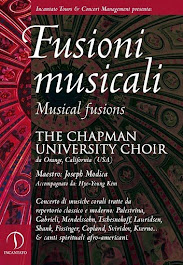
 The Chapman University Choir will celebrate the evening service as the featured guest choir for the Choral Vespers at Berlin's Gedaechtniskirche on Friday, May 27, 2011. 
 
The Protestant Kaiser Wilhelm Gedaechtniskirche stands on the Kurfuerstendamm in the center of Breitscheidplatz in Berlin. The original church was built in the 1890s but suffered terrible damage in a 1943 bombing raid. The spire of the original church has been retained and the ground floor converted into a memorial hall. The present building, consisting of a church with attached foyer and separate belfry with attached chapel, was completed in 1963. The distinctive appearance of the new buildings makes the Gedaechtniskirche one of the most famously recognizable landmarks in Berlin.
The new church, designed by Egon Eiermann, consists of four buildings grouped around the remaining ruins of the original church. A unique concrete honeycomb design, with 21,292, stained glass inlays form the walls of the new church. The vast cathedral houses a 5,000 pipe Schuke organ. Special Plexiglass panels were installed over the organ gallery to improve acoustics. The mass church displays numerous beautiful works of art including a mosaic of the Archangel Gabriel fighting the dragon, a gilt silver altar cross adorned with 37 rock crystals, and the charcoal drawing Stalingrad Madonna—a symbol of hope and reconciliation drawn by Kurt Reuber during the Christmas of 1942 he spent trapped at Stalingrad.

“The Gedaechtniskirche offers a radiant live sound, a true acoustic---not much reverb, but a nice concert hall sound-and a lovely balcony for double choir repertoire.”
-Dr. Jonathan Talberg
Director of Choral, Vocal and Opera Studies
Bob Cole Conservatory of Music, CSULB

Church photo courtesy of German Tourism Board; organ photo borrowed from die-orgelseite.de

Wednesday, September 1, 2010

Concert Venues: Thomaskirche, Leipzig


The great Thomaskirche is one of the main highlights of Leipzig, a town many refer to as the “City of Music.” Thomaskirche houses many renowned musicians, including the Boys Choir, as well as the final resting place of the grand composer Johann Sebastian Bach. Today people come from all over the world to the Church of St. Thomas to experience church services, unique performances from the Boys Choir and the Gewandhaus Orchestra, as well as intricate organ concerts.
Thomaskirche once served as a critical pawn during the Christian Reformation, as Martin Luther often preached in the 12th century church. In 1355 the original Romanesque chancel was remodeled in a Gothic scheme, coinciding with the congregation’s split from the Roman Catholic Church.
Johann Sebastian Bach served as the choir director at Thomaskirche from 1723 until his death in 1750. A statue of Bach standing outside the church’s entrance was dedicated in the composer’s memory in 1908. Although renovations in the mid-1800s resulted in the removal of all Baroque equipment, a commemorative Bach organ, in the style of the original used by Bach, was installed in the sanctuary in 2000. The older romantic organ also remains, but is considered “unsuitable” for playing Bach’s music and is only used when appropriate.
The roof’s unusual 63 degree angle and sanctuary’s intricately designed vaulted ceilings result in unbelievable acoustics and highly complimentary reverberation.
Photo courtesy of Wikipedia


Monday, August 9, 2010

Incantato concert venue: Salzburg Cathedral

Located in Sazlburg, Austria, where the Residenzplatz flows into the Domplatz, the Salzburg Cathedral (Domkirche Saint Rupert) is renowned for its harmonious Baroque architecture and 4,000-pipe organ. It also contains the medieval font in which Mozart was baptized.
The original Romanesque cathedral burnt down in 1598. Prince-Archbishop Wolf Dietrich commissioned for a grand new cathedral to be built in its place, reaffirming Salzburg’s commitment to Catholicism during the Reformation. However, Dietrich’s overthrow prevented the completion of the project, and the present cathedral was completed by Archbishop Markus Sittikus Count Hohenems and consecrated by Archbishop Paris Count Lodron in 1628.  
The cathedral’s plaza, a complete aesthetic conceptualization, is considered one of Salzburg’s most beautiful landmarks. The Virgin’s Column, a 1771 statue of the Virgin Mary rises in the center. Recognized by many as the most perfect Renaissance building in the German-speaking countries, Salzburg Cathedral is adorned with a marble façade, twin west towers topped with large green-roofed domes, and bronze doors illustrating the themes of faith, hope, and love.
Wolfgang Amadeus Mozart, who was baptized in the cathedral, served as the organist there from 1779 to 1781. Some of his compositions, including the Coronation Mass, were written for the cathedral, and many of his works premiered there. 


Photos courtesy of the Salzburg Tourism Board.

Monday, August 2, 2010

Concert Venues: Stiftskirche, Benedictine Abbey of Göttweig, Austria

The abbey, situated on the Göttweig Mountain, is - because of its location - sometimes called the Austrian Montecassino. The Monastery, founded in 1083 by Saint Altmann, sits on a hill 449 m above sea level in the Dunkelsteiner Forest south of the city of Krems, on the eastern edge of the world-famous Danube Valley called the Wachau. With the Wachau, Göttweig was in 2001 placed on the UNESCO World Heritage List.

Goettweig Abbey by Herr Specht.

At first, Augustines worked here, to be followed in 1094 by Benedictine monks from the Monastery of St. Blasien in the Black Forest. The Benedictines have been living, learning and teaching on Göttweig Mountain for more than 900 years. The goal of their life is to glorify God in prayer and work according to the Rule of their Order’s founder, Saint Benedict, the Patron Saint of Europe. Currently 54 monks belong to the monastic community. More than 30 of them give pastoral care to parishioners and pilgrims in the Dioceses of Vienna and St. Pölten. Forestry and viticulture have been the economic basis of the Monastery since it was founded - today completed by various touristic and economic efforts.

"The Stiftskirche is a perfect Baroque chapel, with lovely acoustics, detailed fresco, and choir loft. The tall stairs make for a great riser, and the locale in the hills of Austria is MAGNIFICENT!"
-Dr. Jonathan Talberg,
Director of Choral, Vocal and Opera Studies
Bob Cole Conservatory of Music, CSULB

Concert Venues: Matyas Templom, Budapest


Matyas Templom in Budapest, Hungary, was originally built in 1015 in Romanesque style. Located in the heart of Buda’s Castle District, it is the second largest church of medieval Buda, and the seventh largest of the medieval Hungarian Kingdom.
Officially named the Church of Our Lady, it is popularly known as the church of the king Matyas who ordered the transformation of the church’s original southern tower. The 700 year history of the church serves as a symbol of the city’s rich and often tragic history. The site hosted several royal coronations, including that of Charles IV in 1916, as well as both of King Matyas’ weddings.
Many of the church’s ecclesiastical treasures were shipped to Pressburg in present day Bratislava during the Turkish occupation. Following Buda’s capture in 1541, the church became Budapest’s main mosque. Ornate frescoes previously adorning the interior walls were whitewashed and the furnishings stripped.
In 1686 during the Holy League’s siege of Buda, a wall of the church collapsed from cannon fire. An old votive Madonna statue was hidden behind the wall, and as it appeared before the praying Muslims, the morale of the garrison collapsed and the city fell that very day.
The great architectural boom of the 19th century resulted in the church’s restoration to its original Baroque splendor. Today, the restored cathedral provides visitors with one of the most prominent and characteristic features of Budapest’s cityscape. Visitors enjoy the Ecclesiastical Art Museum and the St. Stephen Chapel located within the vast building. The gallery contains many sacred relics along with replicas of the Hungarian royal crown and coronation jewels.

“The Matyas Templom is one of the most architecturally significant churches in all of Europe. With its Christian and Islamic motifs as well as its gorgeous tile work and acoustic, Hungary's most significant church is a pleasure to behold and to sing in.”
-Dr. Jonathan Talberg
Director of Choral, Vocal and Opera Studies
Photo courtesy of Wikipedia.